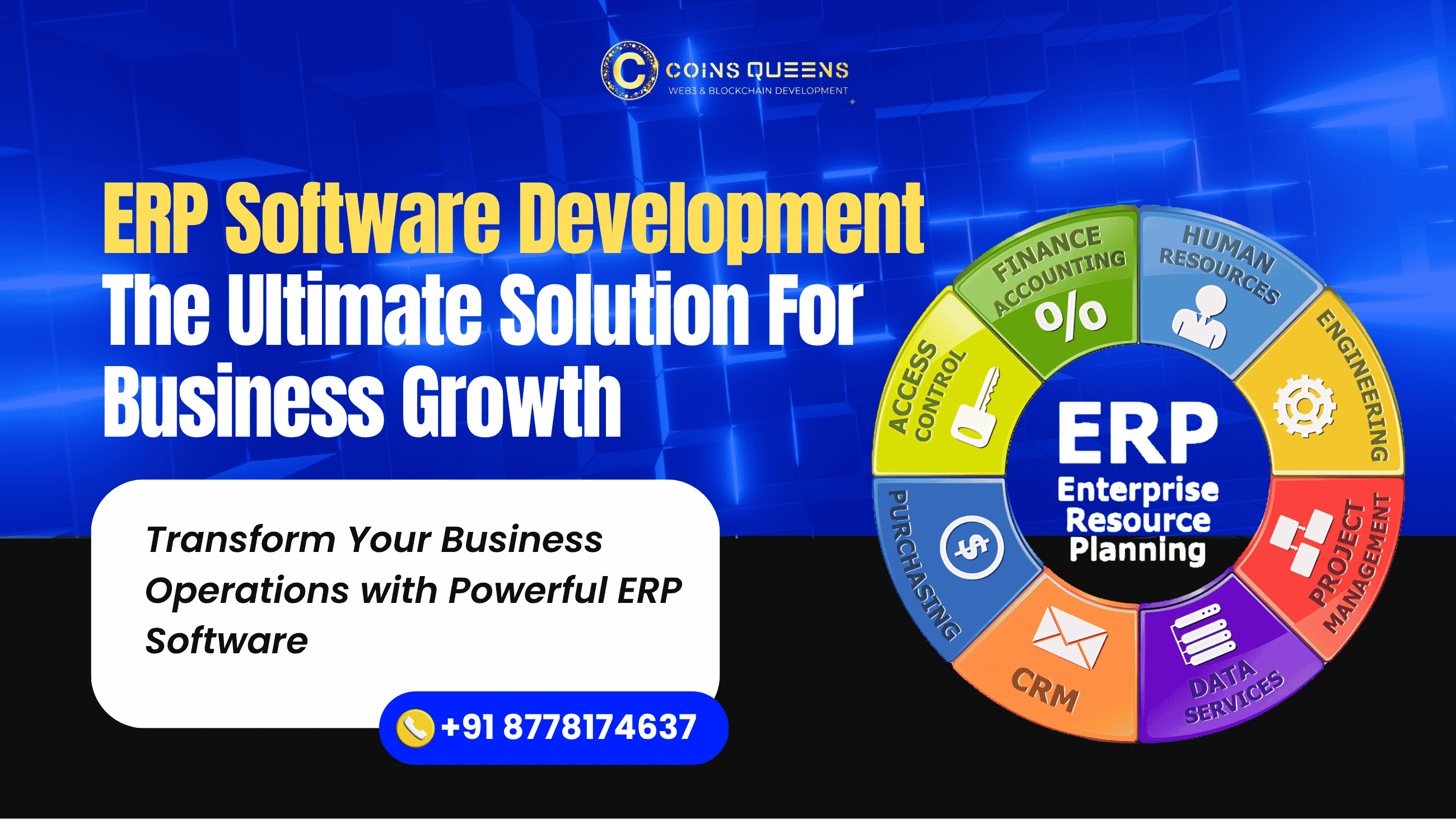
Modern businesses, in the current digital business environment, are constantly seeking the best methods to increase productivity, lower the operating complexities and efficiently managing business process. Businesses that depend on stand alone software solutions will experience delays, lack of communication and data discrepancy which eventually impacts their growth. ERP software development stands as a significant solution for the modern business.
ERP solutions consolidate business processes into a single database enabling companies to gain efficiency and control over workflows. ERP solutions cover a wide spectrum of business activities, ranging from finance, inventory, customer service and human resource to allow companies with full control over operations via a single interface.
Understanding ERP Software Development
The ERP Software development refers to the creation, maintenance, and implementation of the enterprise resource planning (ERP) systems for an organization, consolidating all business operations into a single application. ERP systems allow companies to automate their processes, increase data accuracy, and facilitate internal communication. Normally organizations use multiple isolated applications for accounting, payroll, inventory management, sales and customer relations. Having many disparate systems is inefficient.
Today ERP is fully scalable and fits with various business sectors such as health, retail, manufacturing, logistics, education, finance etc. Custom modules can be adjusted to meet individual organizational needs. There is not only large businesses but also small companies can adopt Enterprise Software. As demands continue to rise Enterprise Software Development is of critical importance for the businesses looking to undergo digital transformation.
Why Businesses Need ERP Solutions
Businesses face several operational challenges as they grow. Manual workflows, repetitive tasks, inaccurate reporting and disconnected departments often reduce efficiency, and profitability. ERP systems solve these problems, by creating a centralized business environment.
A major reason why companies invest in ERP Software Development is the boost of productivity. Workflows can be fully automated, thus saving employees from being occupied with manual processes and enabling them to concentrate on more strategic processes.
Another significant benefit is the visibility of data. ERP solutions make business data instantly available for more timely and accurate decisions. Managers are able to monitor sales, employees, financials, inventory, and customers from one place.
Business collaboration is also increased. As all departments utilize a single system there is increased transparency and communication.
Key Features Of Modern ERP Systems
Modern ERP systems efficiently and flexibly address the complexities of business transactions. Investing in ERP Software Solutions Business is expected of sophisticated features to automate business processes, analytics and efficient workflow management.
Centralized Data Management
ERP system store all of your business data in a single data base. Therefore, all departments can easily share and access business data. It also prevent re entry and improves the accuracy of the data.
Financial Management
ERP platforms help to manage accounts, budgets, invoices, payroll, taxes and reporting in one integrated system. Business efficiency is enhanced through automation of accounting.
Inventory and Supply Chain Management
Inventory modules assist in managing stock levels and in monitoring operations in warehouses and optimizing supply chain processes, thus reducing operation cost and ensuring accuracy of the inventory.
Human Resource Management
ERP systems streamline employee management, attendance tracking, payroll processing, recruitment and performance evaluation. HR teams can handle workforce operations more efficiently.
Customer Relationship Management
The need to have improved customer relationships and sales management in various businesses lead to integrate CRM Development services into ERP systems. CRM capabilities helps to track customer interactions, handle leads, and improve customer satisfaction.
Business Intelligence and analytics
Advanced ERP systems also generate real time reports and analysis to facilitate smart business decisions. Businesses may analyze performance reports and also notice development chances rapidly.
Cloud Accessibility
Cloud based ERP systems allow employees to access business data remotely from any device. This improves operational flexibility and supports remote work environments.
Benefits Of Custom ERP Development
Every business is unique in the way it functions, in the objectives it sets for itself, in the processes that guide its activities. Off the shelf ERP software might not perfectly adapt to your business’s unique needs, causing inefficiencies. Hence, the importance of Custom ERP Development is growing.
Customized ERP solutions provide businesses with complete control over features, integrations and workflows. Companies can build systems, that directly address their operational challenges without unnecessary functionalities.
A major advantage of Custom ERP Software is its ability to scale. As your business grows, you have the ability to add modules and features on demand.
Improved security is another key benefit. Custom built system allows inclusion of more features like enhanced security, appropriate to the business need and the business itself can ensure security of its data.
Custom ERP platforms also improve user experience. Since the system is designed specifically for the organization, employees can work more efficiently with simplified workflows, and intuitive interfaces.
Businesses investing in Enterprise Software Development gain a competitive advantage through optimized operations, improved efficiency, and faster decision making capabilities.
Step By Step Guide To ERP Development Process
A successful ERP system demands meticulous planning, technological knowledge and a thorough understanding of business processes. There are typically a number of stages involved in the ERP Development process.
Requirement Analysis
The first step involves understanding business requirements, workflows, operational challenges and project objectives. Developers identify necessary features, integrations and user expectations.
System Design
During this phase, developers create the system architecture, database structure, interface designs and workflow mapping. Proper planning ensures smooth system functionality.
Module Development
ERPs are built in a module by module fashion, they have Finance modules, HR modules, inventory modules, CRM modules and reporting modules and so on. These modules can be chosen as per the operation requirement by a business.
Integration and Testing
ERP platforms are integrated with third party applications, and existing systems. Developers conduct extensive testing to identify bugs, security vulnerabilities and performance issues.
Launch
Once the testing phases have been completed, the system can be released into the organization. Developers need to make sure that, existing business data can be efficiently transmitted to the system.
Maintenance and upgrades
Regular support and upgrades are needed to assure that, the ERP continues to perform efficiently. And remains secure and compatible with changing business needs.
Businesses partnering with experienced ERP software development services providers can ensure successful implementation and long term system reliability.
Role of CRM in ERP Systems
Customer relationship management has become a crucial part of modern ERP ecosystems. Integrating CRM Development services into ERP systems enables businesses to manage customer interactions more effectively.
CRM modules can track sales leads, help businesses manage their sales funnel, automate follow up, and enhance customer service communication. It will provide companies with a better understanding of customer behavior and interests.
Also, integrating CRM and ERP fosters a greater coordination between sales, support, and finance teams. In return, companies gain the ability to offer personalized service to customers while operating more effectively.
Investing in these ERP software solutions, and also in CRM will help the business in increasing the retention rate, sales numbers and brand image.
Choosing The Right ERP Development Partner
The selection of an appropriate development company is of paramount importance to the successful completion of an ERP project. Companies should look for development companies with substantial technical skills, relevant experience, and customization capacity.
A reliable ERP partner should provide complete ERP software development services, including consultation, design, development, testing, launch and post launch support.
Businesses should also evaluate the company’s experience in Enterprise Software Development and its ability to create scalable, secure, and future ready ERP platforms.
Communication and clarity are just as necessary as the development itself. Businesses should partner with development teams, that comprehend their business objectives, and maintain constant project communication.
Choosing the right technology stack, cloud infrastructure and integration capabilities also contributes significantly to ERP system performance, and scalability.
Future Of ERP Software Development
Artificial intelligence, machine learning, IoT, blockchain and predictive analytics are some of the new technologies determining the future of ERP Software Development. More and more companies are now using intelligent ERPs, capable of decision making automation and efficiency gains in their operations.
Cloud based ERP platforms are expected to dominate the market due to their scalability, flexibility, and cost effectiveness. Mobile accessibility and real time analytics will continue to enhance business productivity.
AI powered ERP systems can analyze large volumes of data, identify patterns and generate predictive insights for better business planning. Automation will further reduce manual processes, and improve workflow efficiency.
As digital transformation accelerates across industries; the demand for custom ERP development will continue to develop.
Conclusion
Companies opting for ERP software development acquire integrated control over processes; while boosting efficiency and enhancing decision making. Given the growing need of upgradability and scalability, the companies opting for Custom ERP development have the liberty to take care of their business specific needs.
Ranging from automation and analysis to CRM capabilities and cloud connectivity, modern day ERP systems offer a unified approach for organizations from a wide array of industries. A company can invest in secure, scalable and future ready ERP software by relying on expert ERP Software Development Services provider.
As businesses continue embracing digital transformation, ERP Software Solutions will remain one of the most powerful tools for achieving operational excellence and sustainable growth.